Glendale Commercial Roofing Questions
Glendale's commercial roofs face long stretches of extreme heat, intense UV, and short, violent monsoon storms.
Commercial Roofing Questions From Glendale Owners
They cover distribution warehouses near Loop 101, retail and hospitality buildings around Westgate and State Farm Stadium, light industrial shops off Northern Avenue and near Glendale Municipal Airport, and older downtown storefronts. We install, repair, and replace TPO, EPDM, industrial, and metal roofs across Glendale and the West Valley communities next to it.
Roof Systems
Do you install TPO roofing on Glendale commercial buildings?
Yes. TPO is one of the systems we install most on low-slope Glendale buildings, especially big warehouse and retail roofs where a white, reflective membrane helps keep heat out of the roof deck.
TPO goes down in wide sheets with hot-air-welded seams, so a large roof ends up with fewer seams than older built-up systems. On Glendale jobs we pay close attention to:
- Membrane thickness, since thicker sheets hold up better to foot traffic around rooftop HVAC units.
- Insulation and cover board, which affect how the roof handles summer heat and hail.
- Seam welding, tested with a probe because a cold weld can let monsoon rain in.
Is EPDM a good fit for a roof in the Glendale heat?
It can be. EPDM is a flexible rubber membrane that stays pliable through big temperature swings, so it suits roofs that move and older buildings with irregular decks.
Standard EPDM is black and absorbs heat, which matters under Glendale's summer sun. White-topped EPDM is an option when reflectivity is a priority. We often suggest EPDM for:
- Smaller office and medical buildings with simple roof layouts
- Roofs crowded with curbs and pipes, where a forgiving membrane helps detailing
- Existing EPDM roofs that need sections replaced to match
The seams are taped or adhered, not welded, so careful seam work matters in monsoon country. See EPDM roof installation and repair.
What does an industrial roofing contractor handle in Glendale?
An industrial roofing contractor takes on large, working roofs: manufacturing plants, distribution centers, cold storage, and shops with heavy rooftop equipment. Many of these sit along the Loop 101 corridor and in the industrial areas near Northern Avenue.
Industrial roofs bring problems that small commercial roofs rarely have:
- Exhaust and process vents that put heat, oils, or chemicals onto the membrane
- Large rooftop units that need reinforced walkways and curb flashing
- Wide spans where small slope problems pond water across big areas
- Strict schedules, because shutting down a production line is costly
We match the membrane to what lands on the roof and plan the work so the floor below keeps running. See industrial roofing for plants and warehouses.
Are metal roofs worth it for Glendale commercial buildings?
For many buildings, yes. A well-installed metal roof can outlast most membranes, sheds monsoon rain quickly on sloped structures, and does well under sun when it has a reflective finish.
Metal works best on pre-engineered steel buildings, shop and hangar-style structures, and retail buildings with sloped roof sections. In Glendale's heat, the panels expand and contract every day, so we focus on:
- Fastener choice and spacing, since loose screws are a common leak source
- Standing-seam clips that let panels move without tearing
- Trim and flashing at transitions, where wind-driven rain gets in
Retrofitting an aging metal roof can also be cheaper than tearing it off. See commercial metal roofing in Glendale.
Which roof system fits my type of building?
The right system depends on slope, rooftop traffic, what vents onto the roof, and how long you plan to own the building. The four systems usually line up with West Valley buildings this way:
| Building type | Common fit | Why it works |
|---|---|---|
| Distribution warehouse | TPO | Large flat area, reflective surface, welded seams |
| Strip retail or restaurant pad | TPO or EPDM | Handles HVAC curbs; EPDM tolerates grease vents better with proper detailing |
| Office or medical building | EPDM or TPO | Flexible over older decks, quiet installs |
| Manufacturing or process plant | Industrial membrane system | Chosen for chemicals, heat, and heavy traffic |
| Pre-engineered steel shop | Metal | Long service life, sheds water fast |
| Hangar or storage near the airport | Metal | Wide clear spans, low maintenance |
An inspection tells us which option fits your roof itself, beyond its building category.
How long do TPO, EPDM, and metal roofs last in Arizona?
With good installation and regular maintenance, TPO roofs typically last around 20 to 30 years, EPDM around 25 to 30, and metal often 40 years or more. Arizona's sun and heat can push any system toward the lower end of its range.
| System | Typical service life | What shortens it here |
|---|---|---|
| TPO | About 20–30 years | UV exposure, poor seam welds, heavy foot traffic |
| EPDM | About 25–30 years | Heat on black membranes, failing seam tape |
| Metal | Often 40+ years | Loose fasteners, worn coatings, corroded trim |
Read these as general ranges for planning. Actual life depends on the product, installation quality, drainage, and upkeep.
Heat And Monsoon
How does Glendale's heat affect a commercial roof?
Heat is the biggest long-term stress on Glendale roofs. Summer highs regularly top 100°F, and roof surfaces run much hotter than the air, which speeds up aging in membranes, sealants, and flashings.
Common heat-related problems include:
- Dried, cracked sealant around pipes and curbs
- Shrinking membranes that pull at edges and corners
- Seam stress on dark roofs that absorb more heat
- Loose metal fasteners from daily expansion and contraction
Reflective membranes, good insulation, and routine sealant checks slow that wear.
What does monsoon season do to flat roofs in Glendale?
Monsoon storms test every weak spot at once. The National Weather Service defines Arizona's monsoon season as June 15 through September 30, and storms in that window can bring strong winds, blowing dust, sudden heavy rain, and sometimes hail.
On low-slope roofs, the trouble usually shows up as:
- Clogged drains and scuppers after dust and debris wash in
- Ponding water on low spots, which strains seams and the deck
- Lifted edges and flashing from straight-line winds
- Punctures from wind-blown debris or hail
A pre-monsoon check in late spring and a post-storm look can catch damage before it reaches the inside of the building.
Questions About Your Own Roof?
Call and describe the building and what you are seeing. We answer what we can on the phone and set up a roof walk for the rest.
Repairs, Upkeep, And Work Days
Should I repair my commercial roof or replace it?
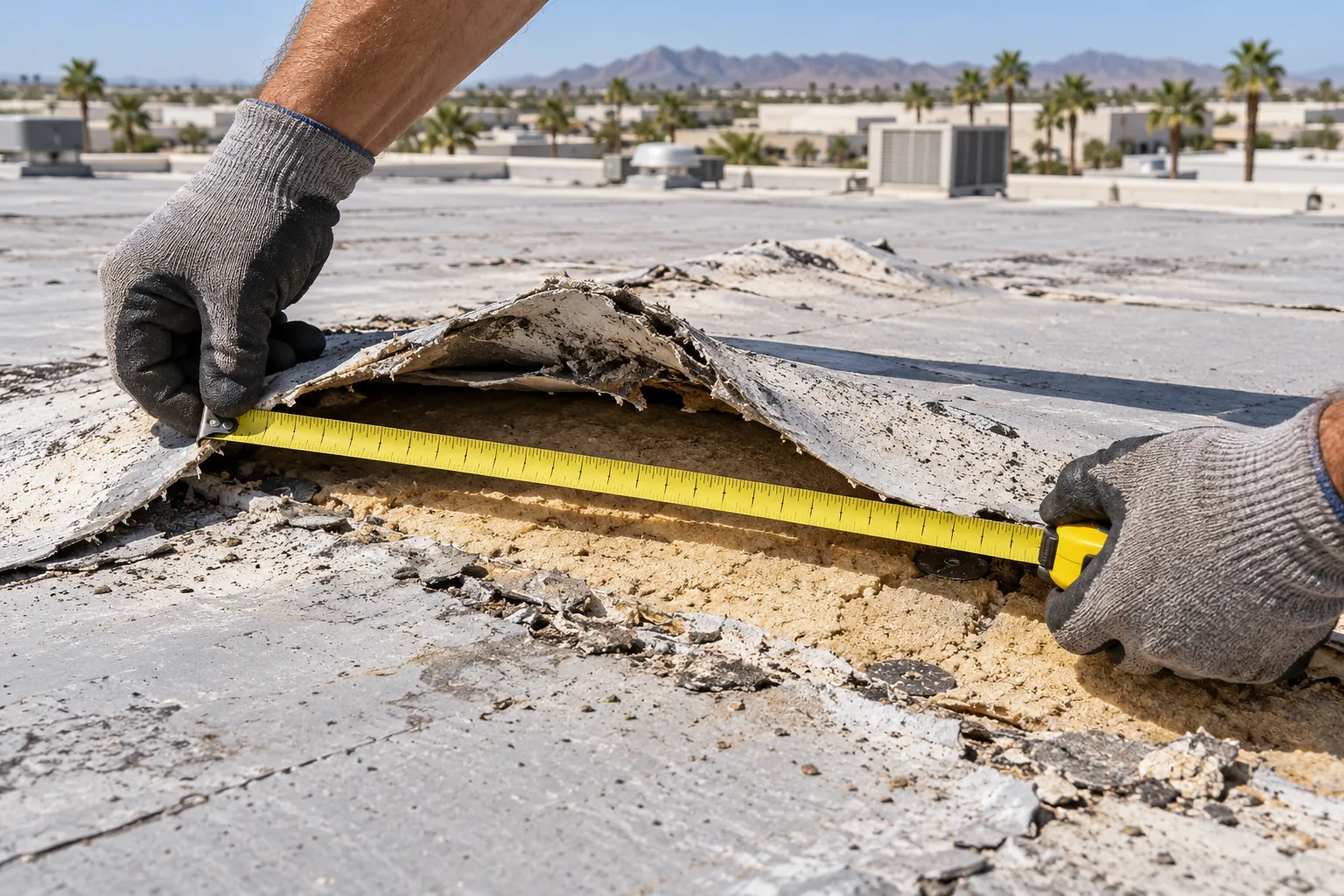
Repair makes sense when the damage is limited and the rest of the roof still has life left. Replacement makes sense when leaks keep coming back, the insulation is wet across large areas, or the membrane is brittle everywhere.
Signs that point each way:
| Usually a repair | Usually a replacement |
|---|---|
| A few failed seams or flashings | Seams opening across much of the roof |
| One storm-damaged section | Widespread blistering, cracking, or shrinkage |
| Dry insulation under the leak | Saturated insulation across large areas |
| Roof well within its expected life | Roof near or past its expected life |
A moisture survey during the inspection shows how far water has spread, which often decides the question.
What maintenance does a commercial roof need in the West Valley?
Plan on at least two inspections a year: one in spring before monsoon season and one in fall after the storms. Check the roof again after any major wind or hail event.
A solid maintenance routine covers:
- Clearing drains, gutters, and scuppers of dust and debris
- Resealing pipe boots, pitch pans, and curb flashings
- Checking seams, laps, and edge metal for lifting
- Tightening or replacing loose metal fasteners
- Looking for ponding and recording where it forms
- Keeping technicians on walkway pads around HVAC units
Small fixes found during maintenance cost far less than the interior damage a missed leak can cause.
Can you work on my roof without shutting down my business?
In most cases, yes. We plan roof work in sections so tenants, customers, and production lines keep operating below.
Before work starts, we go over the details that matter to your operation:
- Work hours, including early starts to beat summer heat
- Staging and crane locations that keep parking lots and loading docks open
- Daily dry-in, so open sections are sealed before crews leave
- Odor and noise, which matter for offices, medical tenants, and restaurants
- Rooftop equipment that may need a brief shutdown or protection
On event-heavy properties near the stadium and Westgate, we also plan around game and concert days.
Permits, Taxes, And Utilities
Who issues roofing permits in Glendale and nearby communities?
Permits come from the city or town where the building sits. In Sun City and Sun City West, which are unincorporated, they come from Maricopa County. A Glendale mailing address does not always mean Glendale city limits, so we confirm the jurisdiction before work begins.
| Location | Permitting authority | Where to start |
|---|---|---|
| Glendale | City of Glendale Building Safety | Glendale building permits |
| Peoria | City of Peoria Building Development | Peoria Development Services Portal |
| Surprise | City of Surprise Community Development | Surprise permits and inspections |
| El Mirage | City of El Mirage | Contact the city's permit center directly |
| Youngtown | Town of Youngtown Community Development | Youngtown permits and plan review |
| Sun City (unincorporated) | Maricopa County Planning and Development | Maricopa County permit information |
| Sun City West (unincorporated) | Maricopa County Planning and Development | Maricopa County permit information |
Whether a reroof needs a permit, and what the city or county wants submitted, depends on the scope. Recovering a roof, tearing it off, and changing structure or rooftop equipment can all be treated differently, so we check with the authority for each project.
Does historic review apply to roofs in downtown Glendale?
It can. Glendale runs a historic preservation program with a Historic Preservation Commission, a local historic register, and a district plan for Catlin Court near downtown.
If your building is on a historic register or inside a designated district, changes visible from the street may need city review before work starts. Low-slope roofs hidden behind parapets are less likely to draw attention than visible sloped roofs. Check with Glendale's Historic Preservation staff to confirm.
Can a new commercial roof qualify for Section 179?
Often, yes. Under federal tax rules, a new roof on an existing nonresidential building can count as qualified real property for Section 179 expensing, as long as the roof goes on after the building was first placed in service.
Key points from IRS Publication 946:
- 2026 deduction limit: $2,560,000, reduced once total qualifying purchases for the year pass $4,090,000
- Eligible buildings: nonresidential property, such as warehouses, retail, offices, and industrial buildings
- Excluded: residential rental property, including apartment buildings
Tax situations vary. Talk with your CPA before counting on the deduction.
Which utility serves my building, and are there roofing incentives?
Parts of the Glendale area are served by APS and other parts by SRP, and the boundary does not follow city limits. Your electric bill shows which utility serves your building.
Both utilities have offered business energy-efficiency programs over the years, but we can't promise a rebate. Programs, funding, and eligibility rules change, and roof-related incentives often require a cool-roof product rated by the Cool Roof Rating Council. Check your utility's current business programs before the roof is ordered, so the right product goes on.
Areas And Getting Started
What areas do you serve?
We serve commercial buildings throughout Glendale, including the Loop 101 and Westgate area, the Northern Avenue industrial area, the airport area, and downtown. We also serve these nearby communities:
How do I get started?
Call us or request a free estimate to set up a commercial roof inspection. We walk the roof, document what we find, and explain your options for repair, restoration, or replacement.
The inspection checks:
- Membrane or panel condition, including seams, laps, and fasteners
- Flashings at walls, curbs, pipes, and skylights
- Drainage, including drains, scuppers, gutters, and ponding areas
- Moisture in the insulation, using a survey where needed
- Rooftop equipment supports and walkway paths
- Interior signs such as ceiling stains or deck rust
You get a clear picture of the roof's condition and which TPO, EPDM, industrial, or metal option fits your building.
- City of Glendale: Building Permits
- City of Glendale: Historic Preservation
- City of Peoria: Development Services Portal
- City of Surprise: Permits and Inspections
- Town of Youngtown: Permits and Plan Review
- Maricopa County Planning and Development: Construction Permit Information
- IRS Publication 946, How To Depreciate Property
- National Weather Service Phoenix
- Cool Roof Rating Council Rated Products Directory
- Arizona Registrar of Contractors
Ready To Have Your Roof Looked At?
Call or send the building address. We walk the roof, document what we find, and explain the options.