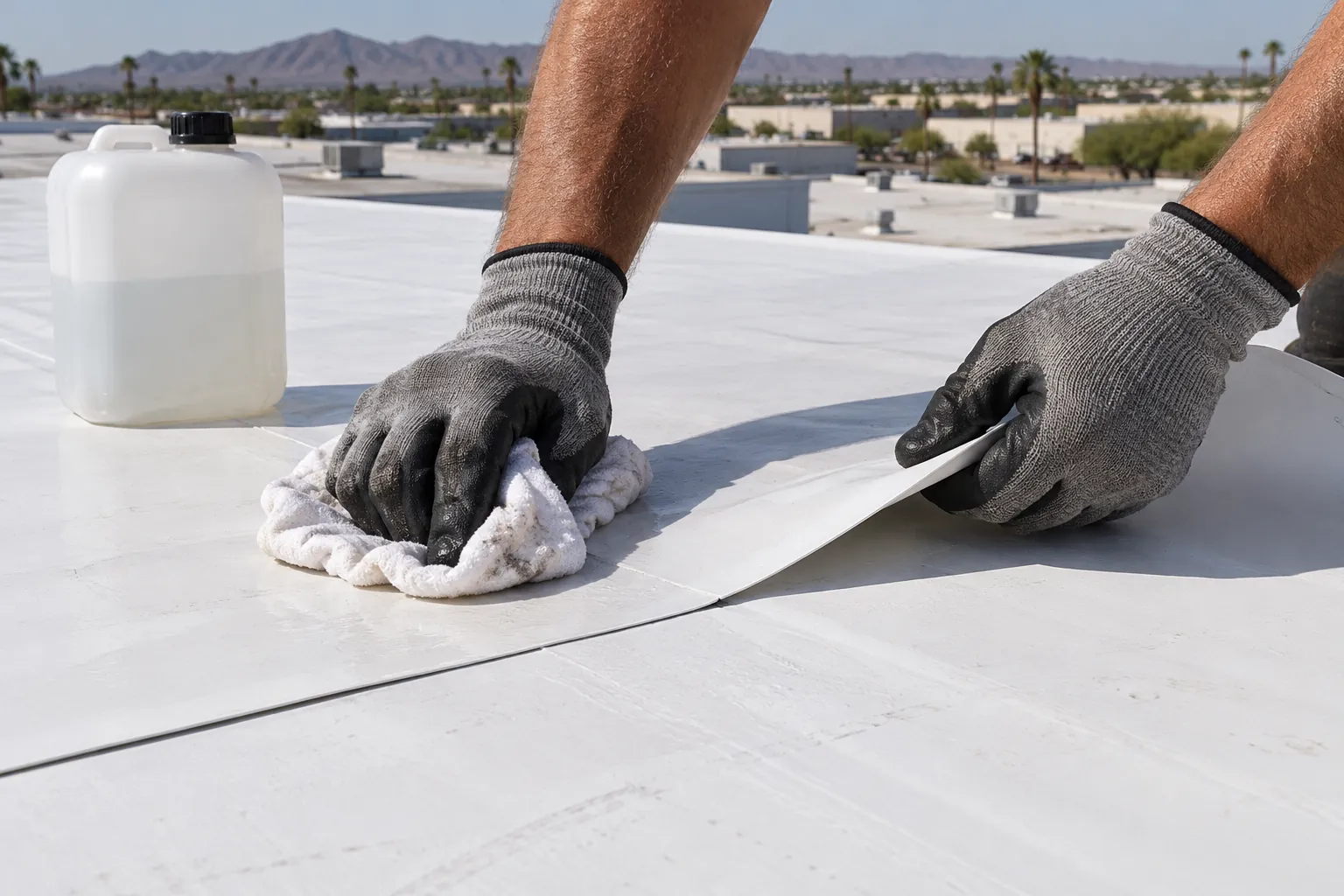
TPO Roofing
A white welded TPO sheet suits larger, open roofs where fewer seams matter more than flexibility.
TPO roofing in Glendale
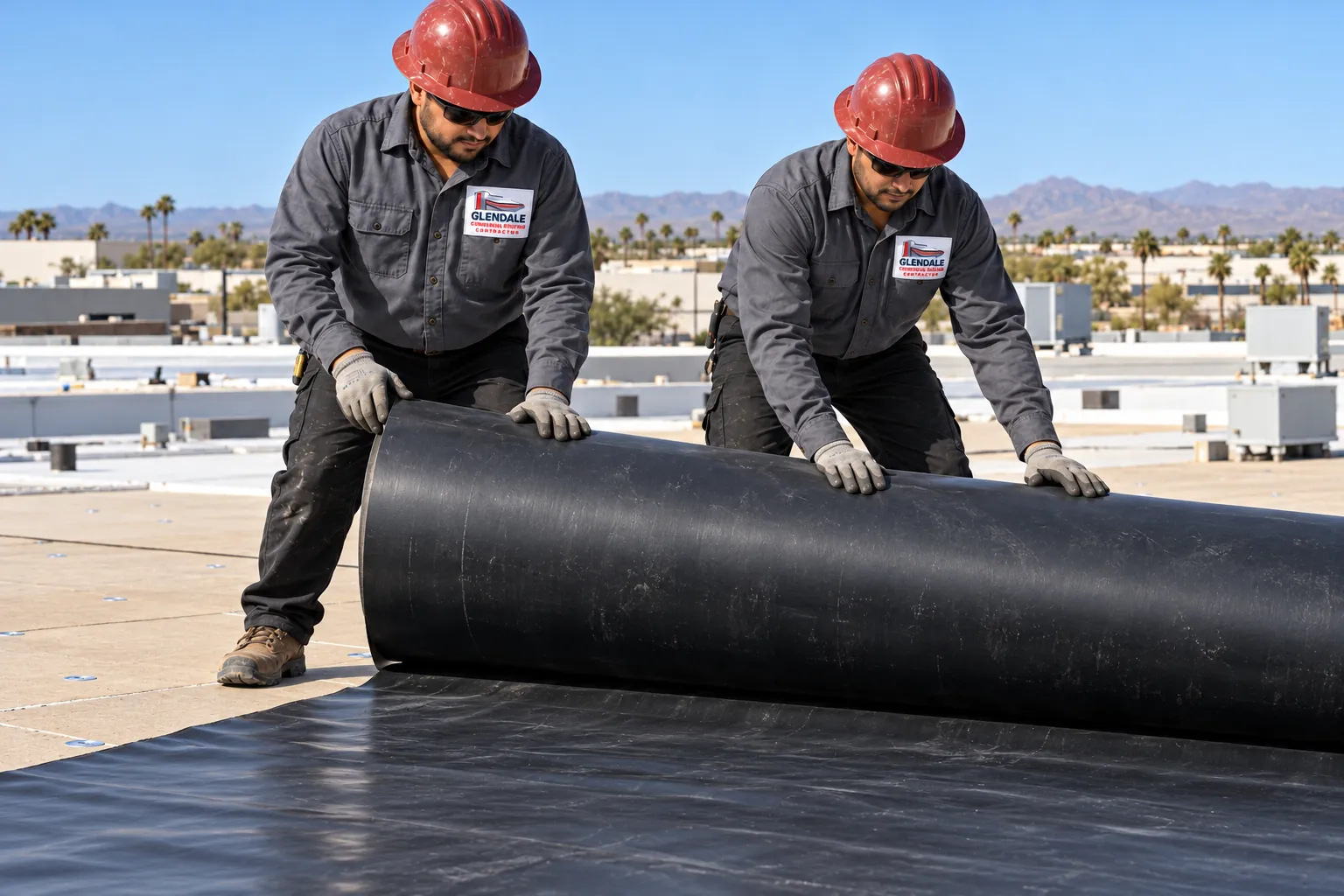
Black and white-topped EPDM for Glendale offices, medical buildings, and roofs crowded with pipes, from an EPDM roofing contractor that re-tapes laps and replaces worn sections.
EPDM suits roofs that move and decks that are far from perfectly flat. Here is where it fits, and where another step comes first.
These show up most when we walk aging EPDM in Glendale.
Tape and adhesive at the laps dry out in the sun and lift at the edges. Open laps let monsoon rain run under the sheet and into the insulation.
Inside and outside corners at parapet walls take the most movement. Flashing there wrinkles, pulls away, and opens a path behind the wall.
Rubber pipe boots and their clamps age faster than the field membrane. A split boot drips straight down the pipe into the ceiling below.
A black EPDM field absorbs summer sun, so the deck and the laps run hotter than they would under a white surface.
Membrane laid loose or pulled by shrinkage forms ridges at the laps, called fishmouths. Water gets in at the open end of each ridge.
Dropped tools and boot heels puncture unprotected EPDM near HVAC units. Small holes are easy to miss until a stain shows up indoors.
Four kinds of EPDM jobs, from a new roof to a single failing lap.
| Job | When It Fits | What Happens On The Roof |
|---|---|---|
| New EPDM install | Tear-off or new building | Insulation and cover board fastened, sheets adhered or fastened, laps taped and rolled |
| Section replacement | One worn area on a working EPDM roof | Damaged area cut out, new EPDM spliced in with matching seam tape |
| Seam and flashing repair | Lifted laps, corner flashing, failed pipe boots | Laps cleaned and primed, new tape and cover strip, boots replaced |
| White-topped upgrade | Black EPDM where heat gain matters | White-topped sheet on new work, or a compatible coating over intact black EPDM |
Four spots where EPDM's flexibility earns its place on a Glendale roof.
The rubber sheet stretches with an older deck as it heats and cools, which keeps stress off the laps and flashings on buildings whose decks were never perfectly flat.
A pliable sheet wraps crowded pipes and small curbs with fewer cuts, so there are fewer seams at the spots most likely to leak.
New EPDM splices into an existing EPDM roof, so a worn section can be replaced while the rest of the system stays, and the repair budget goes where the damage actually is.
White-topped EPDM keeps the flexibility of rubber while reflecting more sun than a black sheet, taking heat off the deck below and off the seam tape at every lap.
Open EPDM laps take on water in the next storm. Call and we will clean, prime, and re-tape the seams that are letting go.
EPDM depends on careful prep at every lap, and on tenants knowing when adhesive days are coming.
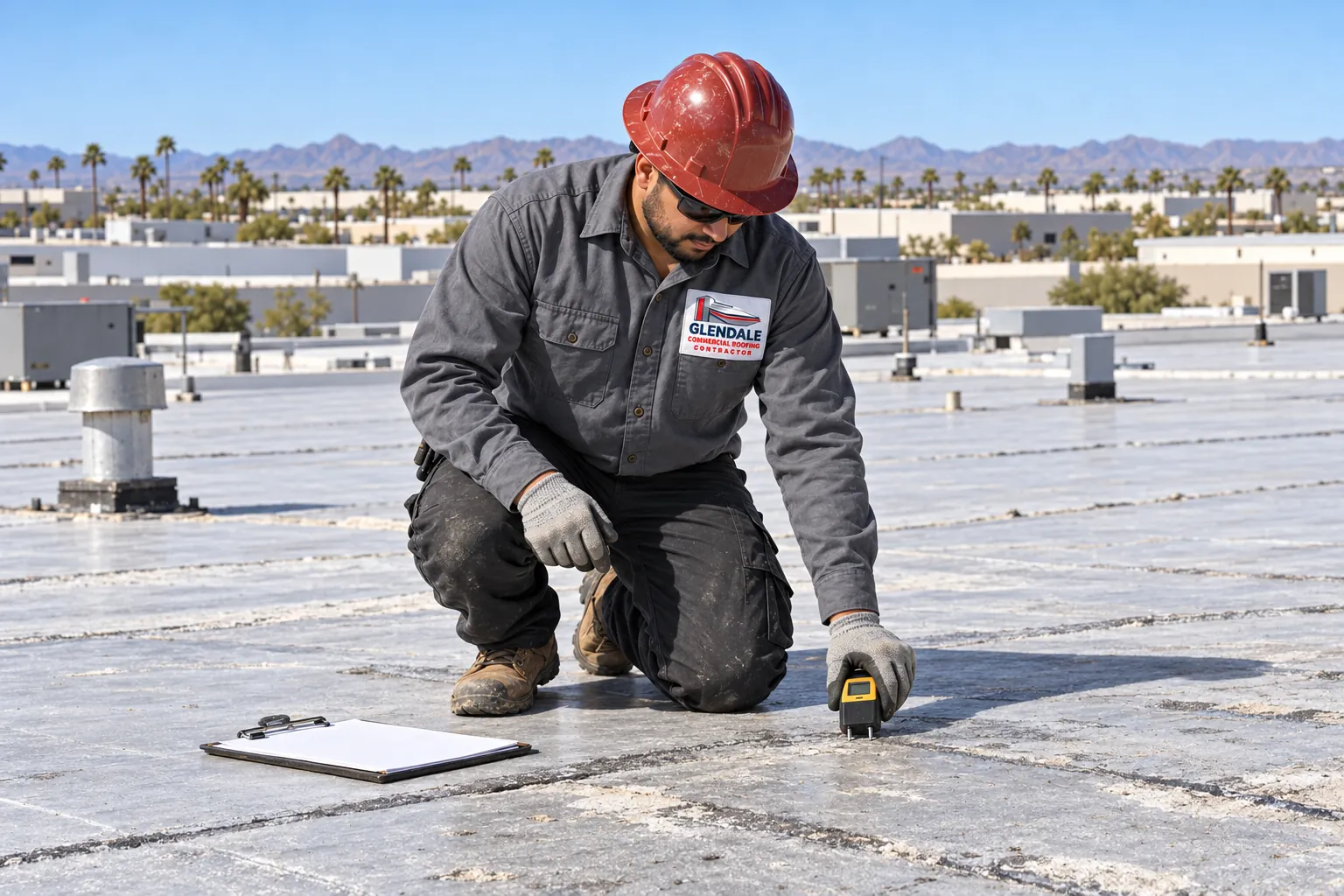
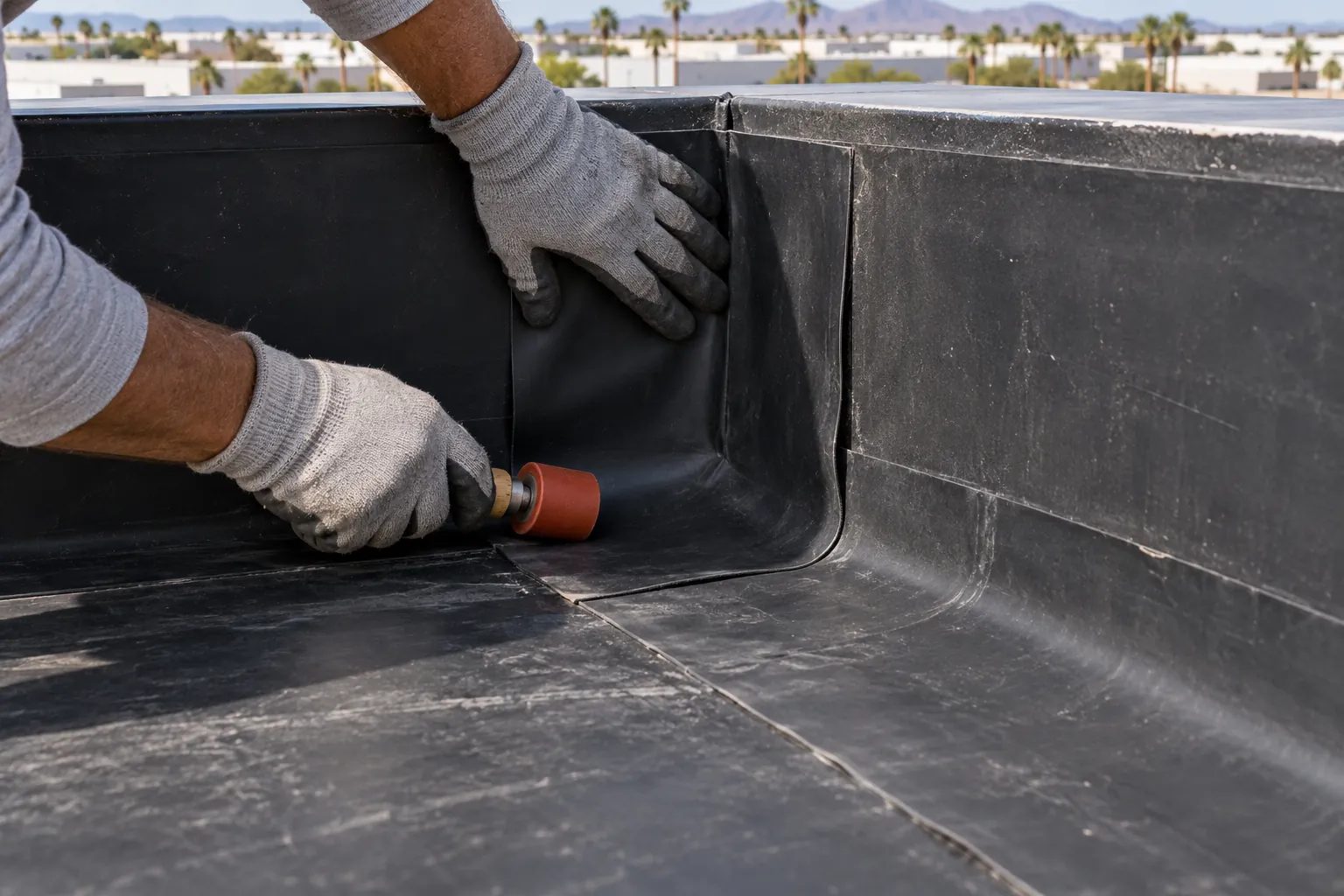
We pull at seam edges, check corner and pipe flashings, and take moisture readings across the sheet. Cores where readings run high show whether the insulation is still dry. Fishmouths and wrinkles at the laps get marked on the roof plan.
Sheet color, thickness, and adhered or fastened attachment are set by the deck, the building's heat load, and how much rooftop traffic it gets. Matching an existing EPDM roof means checking its thickness and seam type first.
Office and medical tenants get notice of adhesive days, and primers stay clear of rooftop air intakes. Staging stays out of patient and customer parking. Adhesive cans and primer stay sealed and shaded until they are used.
Sheets go down over cover board, laps are cleaned, primed, taped, and rolled, and every pipe and curb gets a flashing of its own. Inside and outside corners get pre-formed flashing pieces.
Seams are checked along their full length, corners and boots are inspected, and drains are flushed before the final roof walk with you. Any lap that lifts under a finger gets reworked on the spot.
Systems that often sit next to EPDM on the same building or the same short list.
A white welded TPO sheet suits larger, open roofs where fewer seams matter more than flexibility.
TPO roofing in Glendale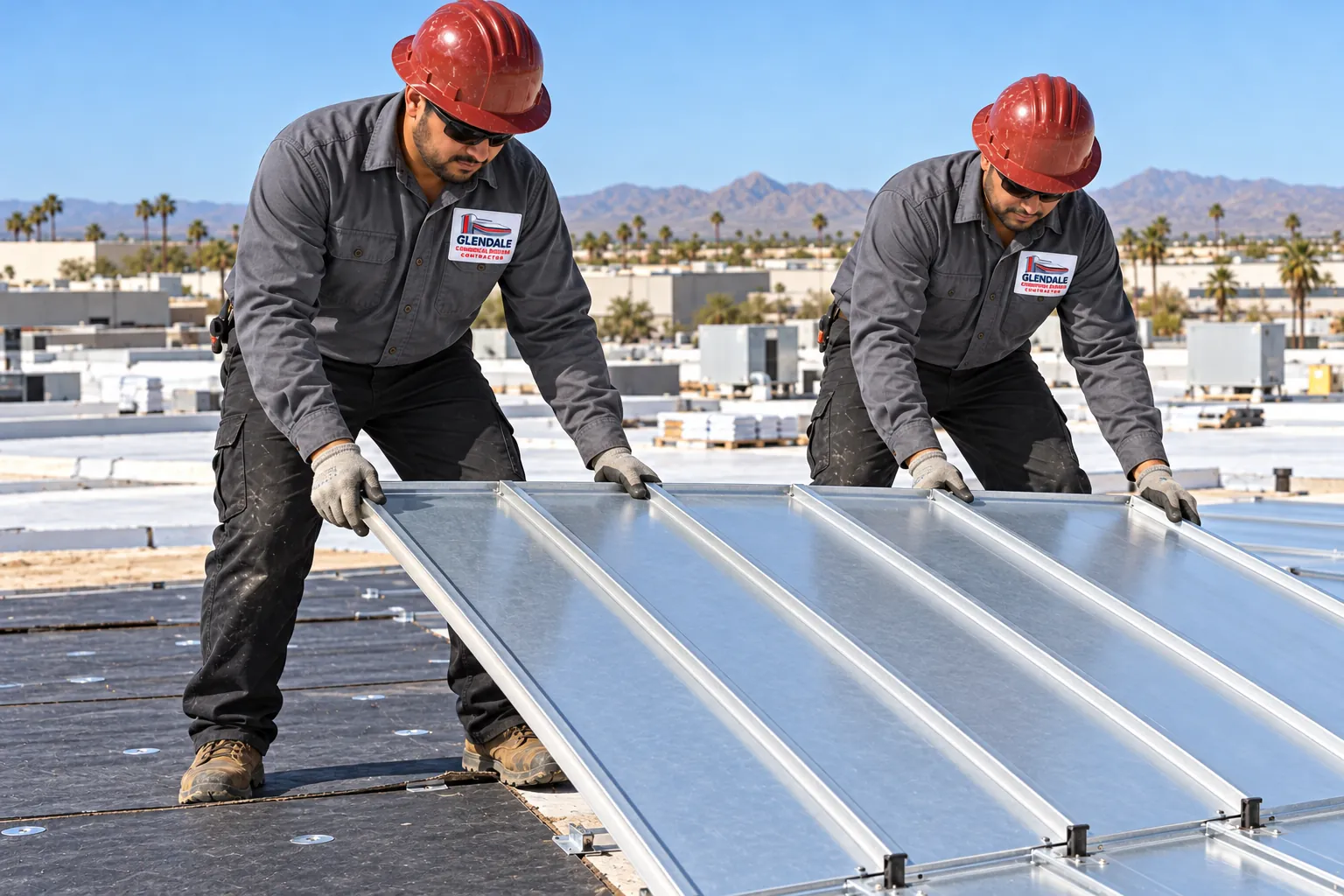
Sloped sections and steel buildings beside a flat EPDM area are better served by metal panels.
commercial metal roofing in GlendaleStraight answers about rubber roofs in Glendale heat.
It can. EPDM stays flexible through big temperature swings, which helps on roofs that move and on older, irregular decks. A standard black sheet soaks up summer heat, so a white-topped sheet is worth a look when reflectivity matters.
With seam tape or adhesive, after the laps are cleaned and primed. EPDM laps are taped or glued rather than heat-welded, so careful prep and rolling at each lap decide how well the seam holds through monsoon rain.
Often, yes. Simple roof layouts with crowded pipes and curbs suit EPDM, and adhesive days can be scheduled around tenants so odor stays away from air intakes.
White-topped sheet reflects more sun and keeps the deck cooler, which matters over offices or patient rooms. Black sheet costs less and works where heat gain is less of a concern, such as over storage.
Sometimes. A compatible coating can go over EPDM that is still in good shape, after cleaning and priming. Laps and flashings get repaired first, because coating over open seams traps water.
Yes. A worn or damaged area can be cut out and new EPDM spliced in with matching seam tape, as long as the rest of the roof is in good condition.
A repair made over dirty, dusty, or wet rubber loses its grip fast. Cleaning and priming take most of the time on an EPDM repair, and that prep is what lets the new tape hold.
It gets replaced. The old boot and clamp come off, the membrane around the pipe is cleaned and primed, and a new boot is flashed in with fresh seam tape at its base.
Tell us the building and what the roof is doing. We walk it, then price repair and replacement side by side.
Leave a name and number and we will call you back about the roof.
Or call now: (623) 310-0165